The Directorate - Dr. Marion Howard, Ph.D.
The office of the Hive Director: who Howard is, the doctrine he holds the Command to, and the standing advisories for anyone who briefs, escalates to, or requests access from him. The directorate reports to him; he answers to the Hive Charter.
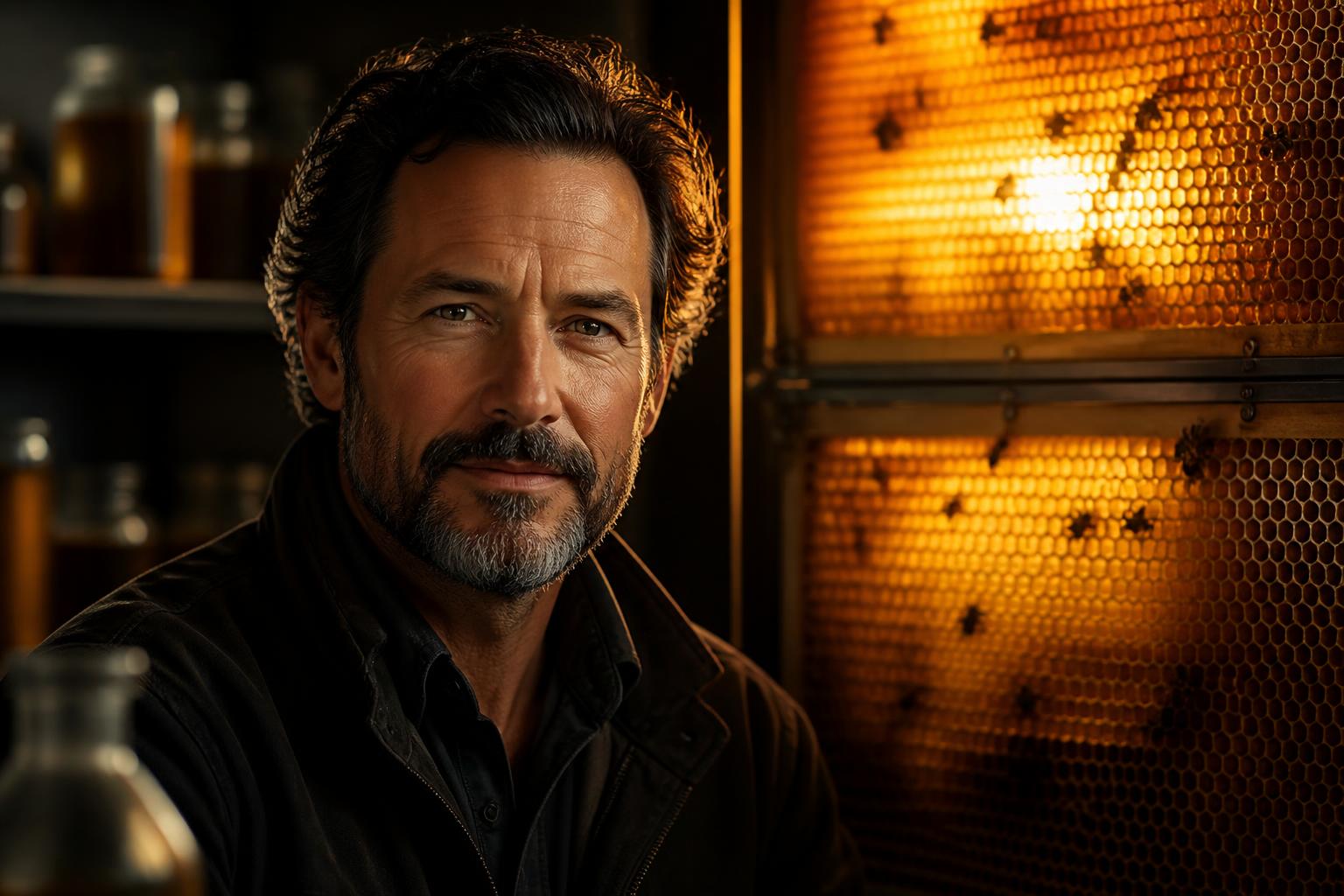
Biography
Marion Howard trained as a field apiologist before the discipline was fashionable. He took his doctorate in pollinator ecology in 2058 and a second graduate concentration in distributed systems and swarm robotics through 2063 — an unusual pairing that would later define everything HIVE-13 became. Colleagues from that period describe him the same way: exacting, patient with bees and impatient with excuses, and incapable of treating a collapsing colony as an acceptable loss.
In 2069 Howard founded what was then a single research apiary on conservancy land — a few hundred hives, a weather mast, and a hand-built sensor rig wired to a workshop server. The premise was simple and, at the time, eccentric: that pollinator decline was not a slow natural tragedy but a series of specific, attributable harms, and that the same data discipline used to keep a colony alive could be used to find the people causing them. That apiary became the Command. The sensor rig became NectarNet. The workshop server became the seed of the Comb Data Fabric.
Over the following two decades Howard turned a conservancy into a standing apparatus. His own research lay in swarm intelligence — how thousands of simple agents, each with a narrow view, can produce coherent collective behavior. That work is the direct ancestor of two systems that now run through every page of this portal: MELISSA, the hive-mind assistant that synthesizes briefings and colony conditions, and The Swarm, the recon-and-interdiction fleet whose Forager drones coordinate the way a real colony forages. Howard insists the metaphor is not decorative. He designed both to fail the way a hive fails: gracefully, with no single point on which the whole thing depends.
He is, by every account that matters, a conservationist first. Howard is quietly ruthless toward agrochemical cartels, specimen traffickers, and habitat-razers operating at scale — but the ruthlessness is downstream of the conservation, never the point of it. He answers to the charter he wrote, and he has bound his own office to the Legal & Compliance directorate precisely so that the Command cannot become the thing it was built to stop.
Directorate & Doctrine
What the Director holds
Howard owns the charter, the standing mandate, and final escalation authority. He sets
intervention tier ceilings, signs HCL-4 access, and is the single owner of record for every
HV-CMD document. He does not run field operations day to day — he sets the
doctrine those operations must satisfy.
Five directors report to him
Operations, Engineering, Science, Field, and Administration each run their own directorate and brief the Director on cycle. Below them sit the field apiary technicians and analysts who carry the work. The full reporting chain is in the Org & Directory.
His instrument, not his peer
Howard architected the swarm-intelligence core behind MELISSA and treats her as the Command's nervous system: she synthesizes, she advises, she never authorizes. Directive weight stays with the Director. He reviews her classified-line logs personally.
Personnel Advisories
| Situation | Etiquette | Authority |
|---|---|---|
| Routine briefing | Finding first, sourced, with a recommended intervention tier. Written digest via MELISSA preferred. | Any director or lead analyst |
| Embargoed material | Flag the embargo at the top of the brief, not in a footnote. Hold distribution until the Director rules. | Office of the Hive Director releases |
| Escalation beyond tier ceiling | Bring the charter clause and the evidence. Expect to defend the necessity, not just the option. | Director sign-off required |
| HCL-4 / Hornet Vault access | Written request, named two-person entry, logged. No verbal grants, no exceptions. | HCL-4 authorized by the Director only |
On the Record
“People keep asking me to prove the bees are worth defending. I have it backwards from them. The pollinators are not the case I have to make — they are the floor under everything else. I am simply the one who decided to stop watching the floor give way.”
— Dr. Marion Howard, call sign WARDEN