Research Logs & Open Questions
Where the Charter sets the mandate to understand and rebuild, the research logs are how that mandate is executed day to day. Each log tracks one live question across the directorate's standing domains — colony health, venom science, swarm intelligence, genetics, field ecology, and the classified programs — with a lead investigator, a status, and an abstract that updates as the work matures.
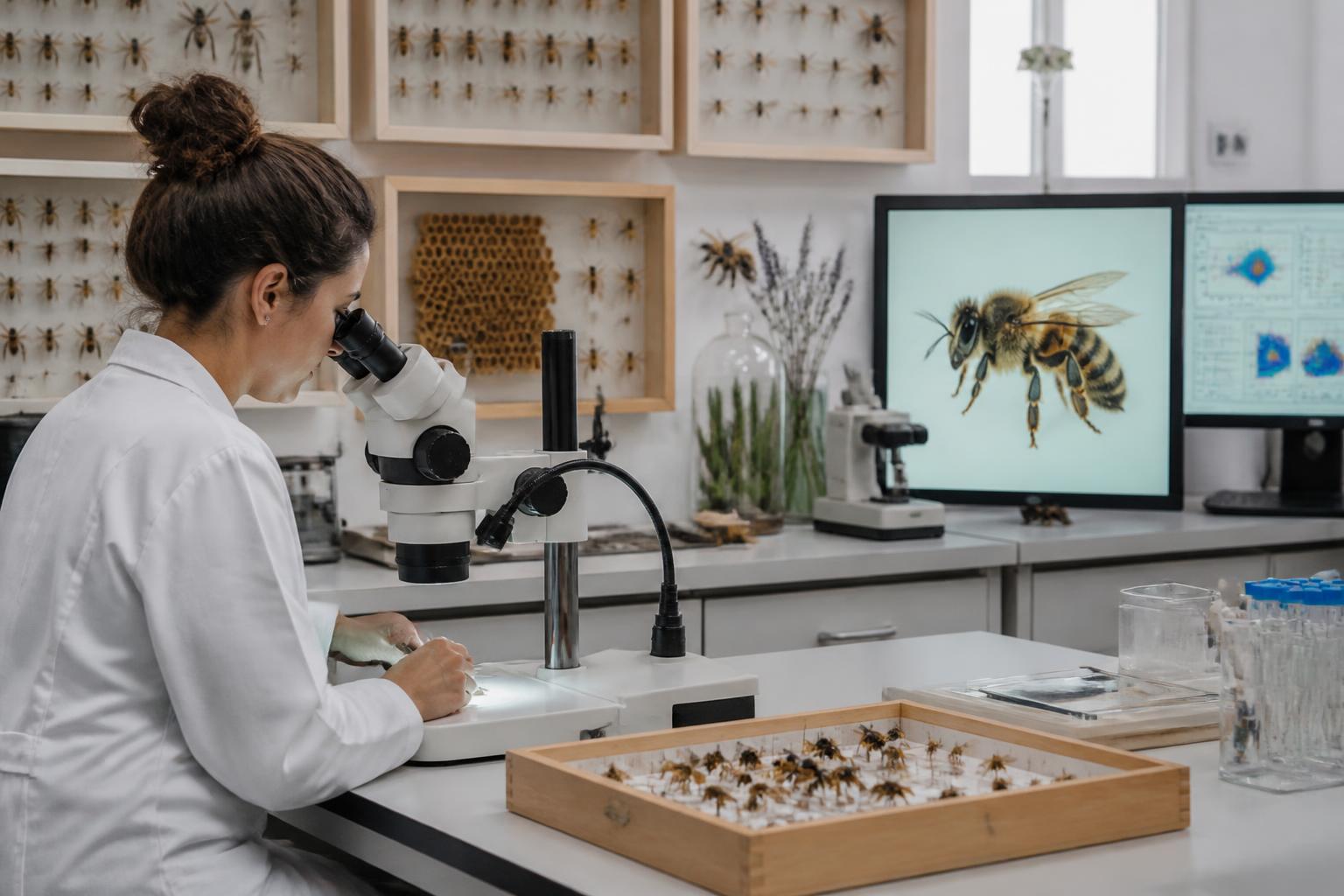
Active Research Logs
Seven threads are open against the current research cycle. Status badges reflect MELISSA's last assessment of each log: ok on track, info early or observational, warn blocked or flagged for review.
HV-RL-2091-008
● On track
Varroa-resistance breeding outcomes, Cohort VII
Logged 2091-02-03 · Lead: Dr. Priya Anand, Genetics
Hygienic-behavior selection in the Cohort VII honeybee lines is holding through a third generation, with mite-bite uncapping rates up sharply over the unselected control. Brood viability has not regressed, which had been the standing fear. The open question is whether the trait survives outcrossing into the rewilding stock without diluting below threshold.
HV-RL-2091-011
● Flagged
Neonicotinoid sublethal effects on foraging fidelity
Logged 2091-03-12 · Lead: Dr. Marcus Vey, Field Ecology
Foragers dosed at field-realistic sublethal neonicotinoid concentrations show degraded waggle-dance precision and a measurable drop in return-to-hive fidelity. The effect is subtle enough to evade acute-toxicity screens entirely. Flagged: the dose-response curve is non-linear and current NectarNet pesticide thresholds may be set too high to catch it.
HV-RL-2091-014
● On track
NectarNet acoustic "piping" classification
Logged 2091-03-27 · Lead: MELISSA, Swarm Intelligence
MELISSA's acoustic model now separates queen tooting from worker quacking with high confidence across the mesh, and has begun resolving pre-swarm "piping" as a distinct signature hours ahead of departure. Early field correlation against colony-weight drops is promising. The open question is generalization across subspecies with divergent acoustics.
HV-RL-2091-017
● On track
Apitoxin / melittin assay results, Series C
Logged 2091-04-09 · Lead: Dr. Lena Sørensen, Venom Science
Series C assays quantify melittin and phospholipase-A2 fractions across the HCL-2 and HCL-3 venom panel, with reproducible yields now achievable from milked stock. The anti-inflammatory fraction isolated last cycle holds up under the new protocol. Licensing review for the purified fraction is pending Legal & Compliance sign-off.
HV-RL-2091-021
● Observational
Bioluminescent night-pollination signaling
Logged 2091-05-02 · Lead: Dr. Marcus Vey, Field Ecology
An observational study of a candidate night-pollinator line that appears to exchange faint bioluminescent cues with a co-evolved night-blooming flora. The signaling is at the edge of instrument sensitivity and may be an artifact, so the log is held at observational status pending a controlled dark-room replication. See Bioluminescence.
HV-RL-2091-024
● Restricted
Engineered Sentinel Forager behavior study Classified
Logged 2091-05-20 · Lead: Dr. Marion Howard (WARDEN), Directorate
A restricted behavioral study of the engineered Sentinel Forager strain — patrol patterning, threat-response thresholds, and recall obedience under MELISSA control. Findings are sealed at the directorate level; this entry is a stub. Access requires Director authorization. Cross-reference: Cryptid & Classified.
HV-RL-2091-027
● On track
Rewilding survival cohorts, Year-Two readout
Logged 2091-06-11 · Lead: Dr. Priya Anand, Genetics
The Year-Two survival readout for the first three rewilding release cohorts shows overwintering rates above projection in two of three corridors, with the varroa-selected line outperforming control. Floral-resource matching at release appears to be the dominant predictor. The open question is whether the gains persist past the genetic founder effect.
Research Domains
Every log is filed under one of six standing research domains. The domains outlive any single log — they are the long-running programs that the directorate carries across cycles.
Colony Health
Disease, parasites, and stressors at the colony scale — varroa, foulbrood, nutrition, and the sublethal chemistry that erodes a hive before it ever collapses.
Venom Science
Apitoxin, melittin, and the HCL venom panel — assay, purification, and licensed therapeutic fractions. Specimen venom profiles live in the Compendium.
Swarm Intelligence
Collective behavior, acoustic and dance communication, and the MELISSA models that classify hive state from NectarNet signal — piping, tooting, and pre-swarm prediction.
Genetics
Selective breeding, resistance traits, and the cryo lines that feed rewilding. Stock, accessions, and lineage records are held in the Genebank.
Field Ecology
Pollinators in the wild — foraging behavior, floral corridors, night-pollination, and the plant–pollinator relationships that field studies trace across whole landscapes.
Classified Programs
Engineered lines and Sentinel strains studied under restricted handling. Sealed at the directorate level; entries here are stubs pending Cryptid & Classified clearance.
rl-*.html) carrying full method, data, and findings. Until then the abstract
above is the canonical entry. Classified logs — including the Sentinel Forager study —
require written authorization from the Hive Director before the detailed page is released.