Production Planning & the 2091 Output Cycle
Production Planning sets what the Conservancy makes, how much, and when — across the public goods that fund Honeyfield and the licensed science that funds HIVE-13. Every target here is paced to a real bloom window and gated by colony health. We plan yield around the bees; we never plan the bees around yield.
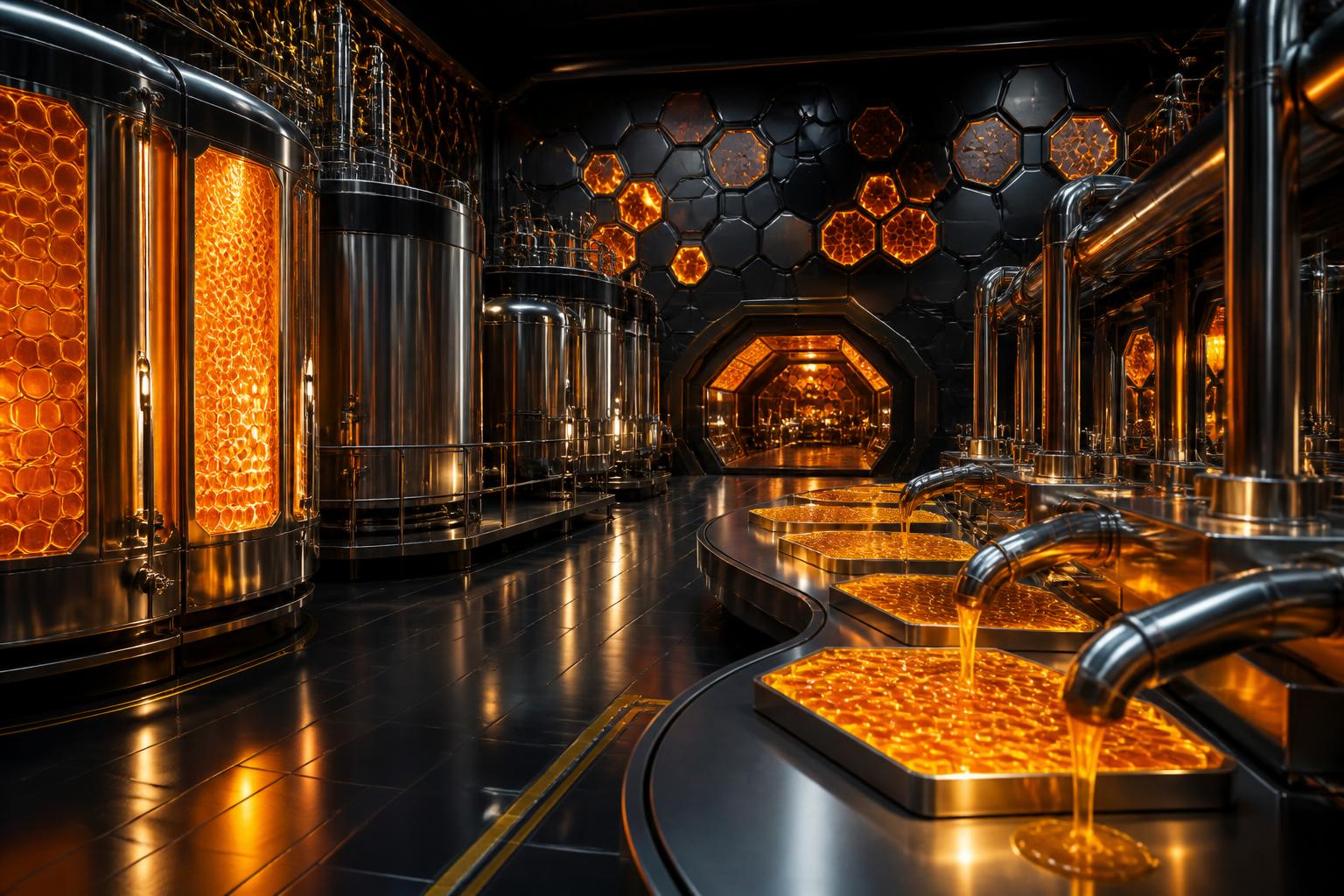
Production Lines
Six standing production lines carry the 2091 cycle. Each is owned by a directorate cell, paced to a bloom or breeding window, and bound by the same welfare doctrine.
Ethically-Harvested Honey & Nectar
Surplus honey and floral nectar drawn only above each colony's overwintering reserve, extracted in the Honey & Nectar processing zone. The Conservancy's flagship public good and its most visible source of independent funding.
Apitoxin & Apitoxin-Derived Material
Bee and hornet venom and its purified fractions, collected by non-lethal stimulation and prepared to research grade for licensed partners. See the Apitoxin Compendium for fractions and handling.
Native-Pollinator Seed Kits & Bee Houses
Region-matched wildflower seed kits and mason- and leafcutter-bee houses for public rewilding at the garden scale — the lowest-barrier way the public joins the mission.
Queen & Nuc Lines
Mated queens and nucleus colonies from the selected breeding lines, sold to vetted keepers and used internally to expand the apiary grid. Pipeline and trait selection in Breeding & Queen-Rearing.
Rewilding Stock
Field-ready colonies and native-bee stock raised for habitat reintroduction rather than sale. A later-phase line that feeds the restoration programs — see Habitat & Restoration.
Beeswax & Propolis Goods
Rendered comb wax and propolis from the same surplus stream — candles, wraps, and balms finished in the processing zone. A small, steady line that turns harvest byproduct into mission funding with near-zero added colony load.
Production Schedule
The 2091 cycle is built backward from the bloom calendar. Targets ramp into the spring and summer flows, taper through autumn, and fall silent over winter while colonies hold their reserves. Outputs are surplus-only by doctrine.
| Line | 2091 Target | Unit | Season / Window | Status |
|---|---|---|---|---|
| Queen & Nuc Lines | 320 | mated queens | Q2 · early spring graft, willow & fruit bloom | On plan |
| Native-Pollinator Seed Kits | 8,000 | kits | Q1–Q2 · pre-season, ships ahead of spring sowing | On plan |
| Honey & Nectar (spring flow) | 4.2 | tonnes | Q2 · clover & orchard main flow | In bloom |
| Honey & Nectar (summer flow) | 7.6 | tonnes | Q3 · lime, heather & wildflower flow | Scheduled |
| Apitoxin Research Material | 540 | grams (dry) | Q2–Q3 · peak forage, peak colony strength | Throughput-gated |
| Beeswax & Propolis Goods | 2,400 | finished units | Q3–Q4 · post-extraction rendering | Scheduled |
| Bee Houses | 1,500 | units | Q4 · winter build, spring dispatch | Queued |
| Rewilding Stock | 60 | field colonies | Q3 · late-summer build-up, Phase 2 | Phase 2 · later |
Capacity & Constraints
Targets are bounded by four hard constraints. None may be exceeded to chase a number; live figures and trend lines are tracked in Metrics & Indices.
Colony capacity
Total productive colonies on the grid set the ceiling on every honey, queen, and venom line at once. Spring splits raise headcount; overwinter losses lower it. Planning holds a reserve buffer so no colony is worked to the edge of its strength.
Apitoxin throughput
Non-lethal venom collection is the binding constraint on the apitoxin line — limited by safe stimulation cycles per colony, HCL-3 handling rules, and purification bench time. This is why the line runs throughput-gated rather than to demand.
Honey & Nectar lines
Extraction, settling, and bottling capacity in the processing zone caps how fast a flow can be turned around. Two concurrent flows (spring + summer) are the planned peak; a third overlapping flow would exceed bench and cold-store capacity.
Gating & quarantine
All living-stock output — queens, nucs, rewilding colonies — passes biosecurity gating before dispatch: disease screening, mite load, and quarantine hold. Gating, not demand, paces how fast living stock can leave the grid.
Demand & Channels
Production feeds two distinct channels that must never be confused on a planning sheet.
Conservancy goods
Honey, seed kits, bee houses, wax and propolis goods, and surplus queens flow to the public through Honeyfield's storefront — the visible, mission-funding face of the program. Catalog and pricing live in Products & Catalog (later phase, linked here for continuity).
Licensed science
Apitoxin and apitoxin-derived material ships only to vetted, licensed research partners under contract — never on the public shelf. Revenue from both channels rolls up into Finance & Funding (later phase, linked here for continuity), which closes the loop back to the mission.