Breeding & Queen-Rearing Program
The breeding wing closes the loop between the Genetics & Cryo-Bank and the living apiary. We graft and rear queens, mate them under controlled conditions, evaluate their daughter colonies against hard survival metrics, and channel the best lines into distribution and the rewild pipeline. The goal is not novelty — it is pollinators that survive the world we have.
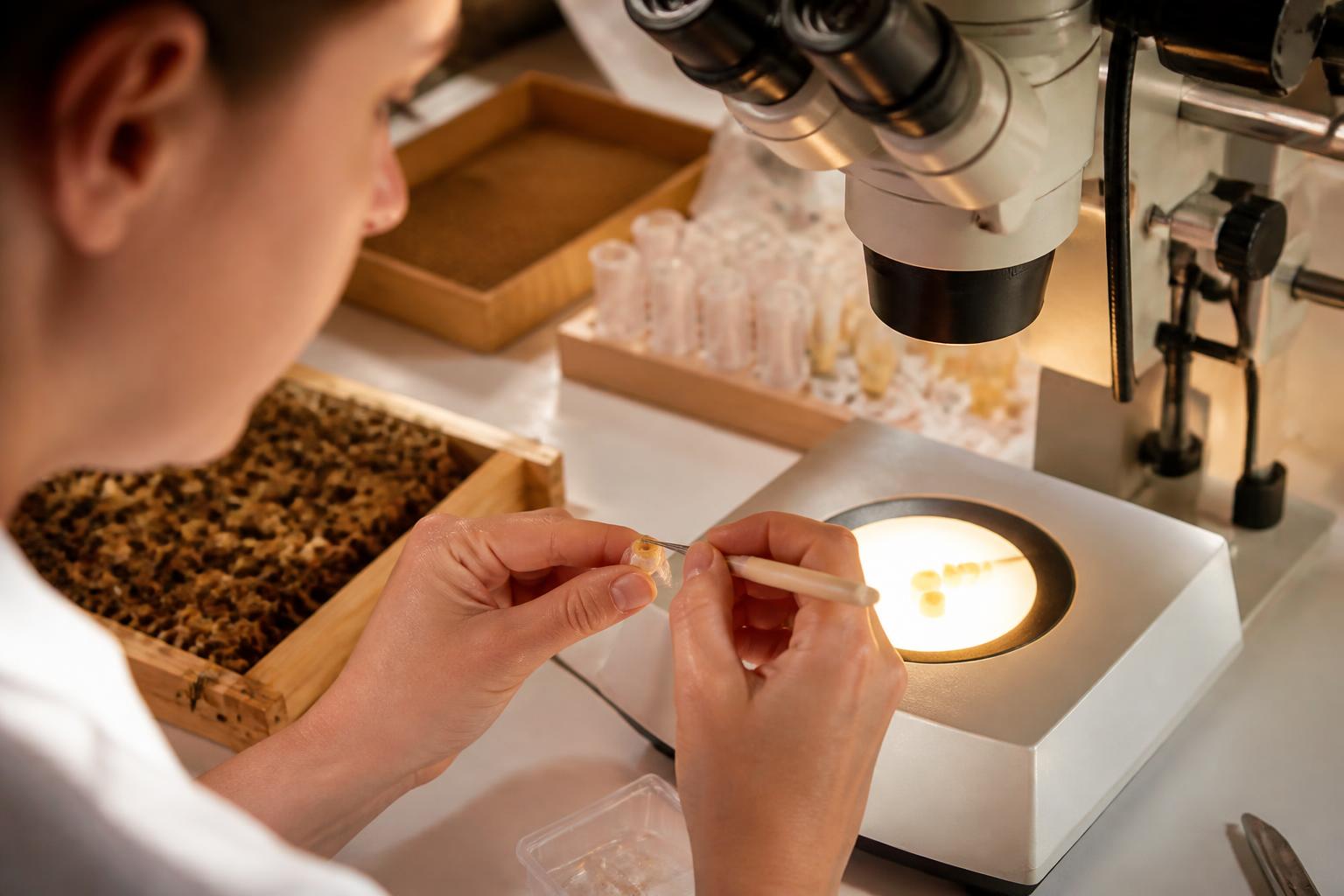
The Breeding Program
Queen-Rearing
Controlled production of mated, evaluated queens from selected mother lines. Grafting, cell-builder management, and instrumented mating nucs let us turn a single proven matriarch into dozens of daughter queens without diluting the trait stack.
Trait Selection
Every line is bred toward measurable, bee-relevant traits — mite resistance (hygienic and grooming behavior against varroa), forage efficiency (nectar and pollen return per flight-hour), and gentleness (low defensive response under inspection). Traits are scored, not assumed.
Rewild Pipeline
Proven open-mated lines graduate from the apiary to release stock. The best survivors feed the Rewilding & Restoration program, which places them into restored floral corridors in a later operational phase.
Queen-Rearing Pipeline
Every queen we distribute passes through the same five-stage flow. Stock is drawn from the Genetics & Cryo-Bank at graft and, for the lines cleared for release, exits into the rewilding program — which receives breeding output in a later phase rather than at first lift.
| Stage | Step | What happens | Gate |
|---|---|---|---|
| 1 | Graft | Day-old larvae are lifted from a selected mother line (sourced via the cryo-bank genetics registry) into queen cups. | Mother line verified |
| 2 | Cell-builder | Queenless, well-fed cell-builder colonies draw the grafts into capped queen cells over roughly ten days. | Cell take ≥ 70% |
| 3 | Mating nuc | Virgin queens emerge into small mating nucleus colonies, take orientation and mating flights, and begin laying. | Confirmed laying |
| 4 | Evaluation | Daughter colonies are scored against the selection metrics — hygienic behavior, varroa load, brood pattern, temperament, forage. | Metrics ≥ line target |
| 5 | Distribution / Rewild | Cleared queens go to internal apiaries, partner stewards, or — for release-grade lines — into the rewild pipeline. | Evaluation record filed |
Active Breeding Lines
Six lines are under active selection this season. Full lineage and generation history for each is held in the Index.
| Line | Species | Selected trait | Gen | Status |
|---|---|---|---|---|
BL-MELLIFERA-01 |
European honeybee (Apis mellifera) | Varroa-sensitive hygiene | G7 | ● Stable |
BL-CARNICA-04 |
Carniolan honeybee (A. m. carnica) | Gentleness · overwintering | G5 | ● Stable |
BL-LIGUSTICA-02 |
Italian honeybee (A. m. ligustica) | Forage efficiency | G4 | ◐ Evaluating |
BL-BOMBUS-03 |
Buff-tailed bumblebee (Bombus terrestris) | Cold-season foraging | G3 | ◷ Trial |
BL-MASON-01 |
Red mason bee (Osmia bicornis) | Orchard pollination yield | G2 | ◐ Evaluating |
BL-MELLIFERA-09 |
European honeybee (Apis mellifera) | Grooming · mite resistance | G6 | ✦ Rewild-grade |
Selection Metrics
Lines are advanced, held, or culled on hard numbers. The current targets and live readings are mirrored from the Metrics board and cross-checked against the Colony Health records.
Hygienic behavior
Percentage of freeze-killed or pin-killed brood uncapped and removed within 24 hours — the front-line defense against varroa and brood disease.
Target ≥ 95%Fleet avg 92%
Varroa load
Mites per 100 bees by alcohol wash, sampled monthly through the season. Low and stable without treatment is the signal of genuine resistance.
Target < 2.0Action ≥ 3.0
Overwinter survival
Share of evaluation colonies alive and queenright at spring inspection — the single toughest test of a line's resilience.
Target ≥ 85%Last season 88%
Forage index
Composite of nectar and pollen return per flight-hour against floral-resource load, drawn from NectarNet forage telemetry.
Target ≥ 1.10Fleet avg 1.04