Emergency Drill & Readiness Program
Readiness is doctrine, not luck. This page defines the standing drill catalogue HIVE-13 rehearses, the four-color alarm and escalation ladder that governs every emergency, the muster procedure and role assignments each technician memorizes, and the record of recent and upcoming exercises. When the alarm sounds — drill or real — the floor responds the same way.
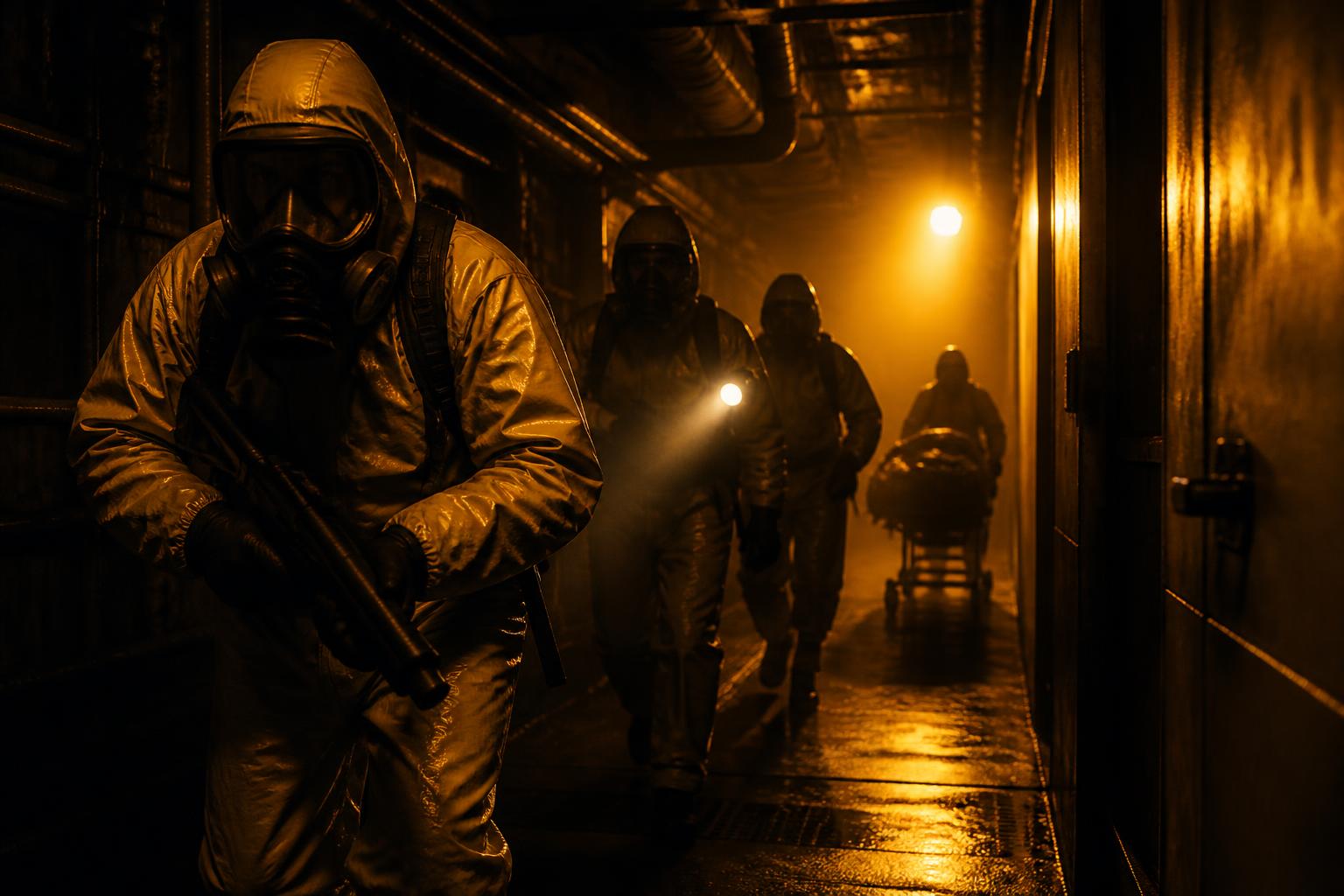
Drill Catalogue
Eight standing exercises form the readiness program. Each carries a scenario, a rehearsal cadence, and a severity grade that sets how seriously the floor must treat a real-world equivalent.
Hornet-Vault Breach
HCL-4 containment failure — a Goliath Sentinel or Royal Guard line loose inside the Vault airlock. Seal, isolate, account for all handlers, stage antivenom.
HCL-4 Cadence · Monthly
Venom / Anaphylaxis Response
Mass envenomation or anaphylactic collapse on the apiary grid. Triage, epinephrine, antivenom staging, and handoff to the on-site medical bay.
HCL-3 Cadence · Monthly
Mass Colony-Collapse Surge
A cascading collapse event across the Universal Pollinator Index — emergency cryo, brood-rescue, and NectarNet triage to preserve viable lines.
Index Cadence · Quarterly
NectarNet / MELISSA Outage
Loss of the sensing fabric or the hive-mind assistant. Fall back to manual watch rotations, paper SOP digests, and the Waggle-Protocol backbone.
Systems Cadence · Quarterly
Drone-Swarm Loss-of-Control
A Forager or Hornet-class craft off-nominal in the air. Ground the fleet, assert kill-switch authority, and clear the flight corridor.
The Swarm Cadence · Quarterly
Facility Fire / Biosecurity Breach
Fire, smoke, or a breach of the biosecurity envelope. Evacuate by zone while holding containment integrity on every HCL cell that can be held.
Facility Cadence · Semi-annual
Hostile Exposure of the Command
A cartel or syndicate moves to expose, locate, or strike HIVE-13. Lock down, scrub comms, and execute the continuity-of-command protocol.
Classified Cadence · Semi-annual
Field-Team Extraction
A forward team compromised, injured, or cut off in the field. Recall, route a Skep command vehicle, and recover personnel under intervention doctrine.
Field Cadence · Quarterly
Alarm & Escalation Tiers
Every emergency — drill or real — is announced on a four-color ladder. MELISSA raises the alarm automatically from NectarNet telemetry; the floor confirms and escalates from the Live Dashboard. The MELISSA Console is the authoritative voice of record for tier changes.
| Tier | Trigger | Response |
|---|---|---|
| GREEN | Nominal. No active hazard; routine watch and scheduled drills only. | Standing rotations. No action beyond normal duty and the published drill schedule. |
| AMBER | Anomaly detected — sensor drift, single-cell deviation, MELISSA flags a watch condition. | Zone wardens verify on the Dashboard. Brief leadership. Stage response, do not yet muster. |
| RED | Active emergency — envenomation, containment slip, fire, or fleet fault confirmed. | Full muster. Drill marshal takes the floor; roles activate; affected zone isolates. |
| BLACK | Catastrophic — HCL-4 breach, hostile exposure of the Command, or loss of containment integrity. | Facility lockdown. Director notified and in command. Continuity protocol; external comms scrubbed. |
Muster & Roles
On any RED or BLACK alarm the floor musters to the same procedure. Each technician knows their muster point and their assigned role before the alarm ever sounds.
Standard Muster Procedure
- Stop work. Make your specimen or station safe to leave, or hold containment in place.
- Acknowledge the alarm tier on the nearest panel or via MELISSA.
- Move by your assigned route to the zone muster point — never through the affected zone.
- Report in to your zone warden for headcount; a missing name escalates immediately.
- Hold at muster for role tasking; do not re-enter a zone without marshal clearance.
- Stand down only on the marshal's all-clear, confirmed on the Live Dashboard.
Role Assignments
- Drill Marshal — owns the floor for the duration; declares muster, tasks roles, calls the all-clear.
- Zone Wardens — one per zone; run headcount, route their people, report status to the marshal.
- Medical Lead — triage, epinephrine and antivenom staging, handoff to the medical bay.
- Comms Officer — holds the MELISSA channel, logs tier changes, manages internal notification.
- Containment Officer — verifies HCL cell integrity and Hornet-Vault seals before stand-down.
- Recorder — timestamps every action for the after-action drill record.
Drill Schedule & Records
Recent and upcoming exercises for the 2091 readiness year. Results feed the after-action record held by Field Operations.
| Date | Scenario | Tier exercised | Result / Status |
|---|---|---|---|
| 2091-02-14 | Venom / Anaphylaxis Response | RED | Passed |
| 2091-03-09 | NectarNet / MELISSA Outage | AMBER | Passed w/ findings |
| 2091-04-21 | Hornet-Vault Breach (HCL-4) | BLACK | Passed · Director-reviewed |
| 2091-05-30 | Facility Fire / Biosecurity Breach | RED | Passed |
| 2091-07-12 | Field-Team Extraction | RED | Scheduled |